Leak Detection in Mount Pleasant, TX That Finds the Source
Leak detection is the professional locating of a hidden water leak in a Mount Pleasant, TX home before walls or floors are opened. Leak detection in Mount Pleasant, TX for slab leaks and hidden leaks — a warm spot on the floor, a water bill that jumped, or a sound behind the wall. Acoustic and thermal methods narrow down the source before any floor is opened. Call NTP Plumbing at (903) 350-9085 — open 24 hours, Monday to Sunday, for leak detection.
A leak detection visit finds the source before anything is opened up. Here is what comes standard on a Mount Pleasant, TX leak detection visit.
Slab leak detection
A leak under the slab shows up as a warm spot, a sound in the floor, or a bill that jumped. Acoustic and thermal methods narrow down the spot before any concrete is disturbed.
Hidden leak detection
A leak behind a wall or under a floor wastes water and raises the bill without showing a puddle. We narrow it down with pressure testing and listening methods, not guesswork.
High water bill investigation
A bill that suddenly jumps usually means a supply-line leak. We check the meter, test the pressure, and narrow down whether the leak is inside the house or in the service line.
Water service line check
A leak in the line from the meter to the house shows up as a soggy yard or a meter that runs when every tap is off. We test the line and narrow down the spot.
Pre-purchase plumbing check
Buying a home in Mount Pleasant, TX? A leak check before closing can find a slab leak or a service-line leak that a walkthrough cannot see. Ask us what the check covers.
Homes and rentals in Mount Pleasant, TX
A warm spot on the floor in a home you live in and a damp floor in a rental unit both need the same thing first: the source narrowed down before anything is opened. What changes is who meets us at the door, who gets the findings, and whether the fix is a spot repair or a reroute.
For homes and rentals
Homes and rentals get the same detection: the symptoms, the meter check, and the listening methods that narrow down the source. We explain what we found before anything is opened up.
Warm spot on the floor
Water bill suddenly higher
Sound of running water with taps off
For property managers and landlords
Property managers and landlords need the leak found and the findings documented. We narrow down the source, photograph what we can show, and explain the repair so the work order is easy to close.
Tenant reports a high water bill
Damp floor in a rental unit
Meter running with taps off
What leak detection in Mount Pleasant, TX actually involves
A plain-language look at what leak detection involves and why the slab is the first suspect. The City of Mount Pleasant charges a $75 residential plumbing permit fee where a permit is required (inside city limits) — that is a City fee, not our price.
The job starts with the symptoms, but the work is measurement. A warm spot on the floor, a water bill that jumped, a sound of running water when every tap is off, or a meter that keeps running all point to a supply-line leak — and the first question is where, not what to cut. We check the meter with every tap off, test the pressure to find the hot or the cold side, then use acoustic and thermal methods to narrow the source to a spot before any floor is opened. Detection work follows the 2024 International Plumbing Code Mount Pleasant adopted under Ordinance 2026-2, effective 20 January 2026 — the code that governs how a located leak is repaired, not just found. When the leak is found, the repair is a leak repair question, and we will explain what it involves.
Detection starts with the ground the house sits on. The citywide median build year is 1978, and much of the in-town stock sits on slab-on-grade foundations over East Texas clay that swells when wet and shrinks when dry — movement that fatigues rigid pipe joints and buried copper, and can fail under-slab lines through corrosion, friction, and shifting soil. Homes built from the 1940s to the 1960s commonly have galvanised supply lines corroding internally, and cast-iron drains that crack from soil movement. A slab leak will not show up as a puddle, so it often goes unnoticed until the bill jumps or the floor warms — which is why the meter and the listening methods do the finding, not a guess at where to cut. Our guide to lowering your water bill explains how a hidden leak shows up on the bill first.
A leak you cannot see still wastes water every hour. The listening methods find it before the floor is opened.
When you need it
When the bill jumps, the floor warms, or water runs when every tap is off.
What to expect
A meter check, a pressure test, acoustic and thermal narrowing, and a plain-language findings report.
Permits and code
Work on leak detection follows the 2024 International Plumbing Code adopted by Mount Pleasant (Ordinance 2026-2, effective 20 January 2026); permits are handled when required.
What to expect when you call
A leak detection visit should feel like a plan, not a panic. Here is the sequence from your first ring to a located leak.
Call and describe
Tell us what you noticed — a warm spot, a bill that jumped, a sound behind the wall, or a meter that runs with the taps off. That tells us whether the leak is inside the house or in the service line.
Symptoms noted
Meter check planned
Visit set
Meter and pressure check
We check the meter with every tap off, then test the pressure. A meter that runs with the taps off means water is leaving the system somewhere, and the pressure test tells us whether it is the hot or the cold side.
Meter checked
Pressure tested
Side narrowed
Narrow down the source
We use acoustic and thermal leak detection methods to narrow down the spot — listening for the sound of water escaping, and looking for the temperature pattern a hot-water leak leaves in the floor.
Listening done
Thermal pattern checked
Spot narrowed
Confirm the finding
We confirm the finding with a second check before anything is opened up, so the repair targets the leak — not a guess about where it might be.
Finding confirmed
Location marked
Repair explained
Walkthrough and next steps
Before we leave, we explain what we found, where the leak is, and what the repair involves — including whether a spot repair or a reroute is the better call for an older home.
Findings explained
Options laid out
Next steps set
Tools and methods we bring to the job
The listening methods decide the repair. Here is what we use on leak detection calls in Mount Pleasant, TX.
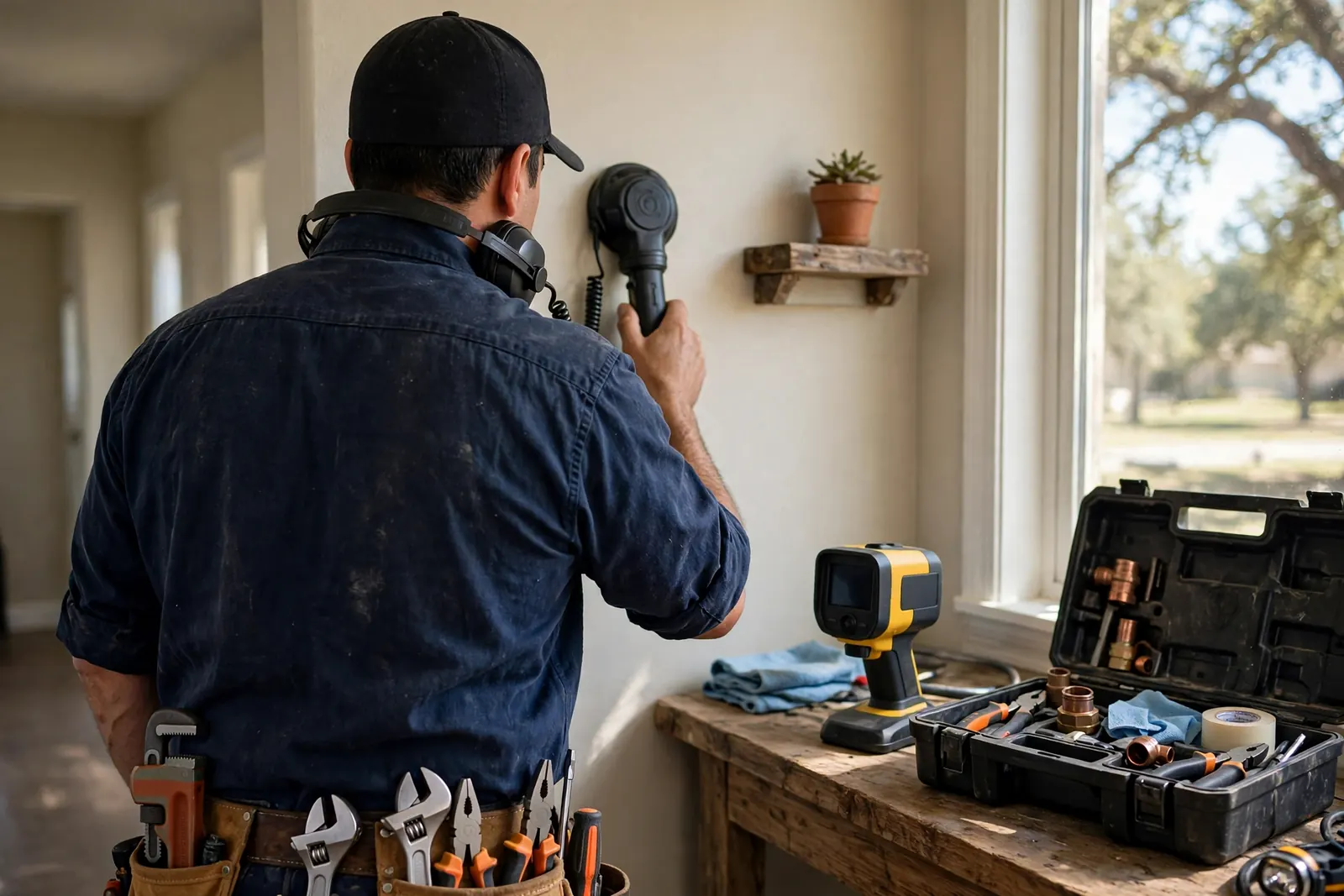
Acoustic listening
Listening methods that narrow down the sound of water escaping under a slab or behind a wall, so we locate the leak with less digging.
Thermal imaging
Temperature patterns that help point to a hot-water leak under a floor or inside a wall, used alongside pressure testing to confirm the finding.
Pressure gauge
Confirms the system holds after a repair and helps diagnose hidden leaks by showing pressure loss — and whether the leak is on the hot or the cold side.
Water meter check
The meter tells us whether water is leaving the system with every tap off, and how fast it is going.
Moisture meter
Checks walls and floors for damp that has not yet shown on the surface, so the damage is found early.
Thermal views are illustrative, generated from photographs of leak detection work in Mount Pleasant, TX.
Methods
Acoustic and thermal methods
We use acoustic and thermal leak detection methods to narrow down the source. They are methods, not magic — the finding is confirmed with a second check before anything is opened up.
Spot repair vs reroute
For an older home, rerouting a line through the walls or the attic is often the better call than breaking concrete. We explain both options when the leak is found.
2024 International Plumbing Code
Every located leak is repaired to the code Mount Pleasant adopted under Ordinance 2026-2, effective 20 January 2026.
Meter-first diagnosis
We check the meter with every tap off before anything else, so a leak is confirmed before the listening starts.
Hot vs cold side
A pressure test tells us whether the leak is on the hot or the cold side, which narrows the search to half the lines in the house.
Permits handled when required
Where a leak repair needs a City permit, we handle it. Permits are handled when required, and leak detection work is inspected to code.
When to call for leak detection
Warm spot on the floor
A homeowner notices a warm spot on the floor and a water bill that has doubled.
We check the meter, test the pressure, and use acoustic and thermal methods to narrow down the spot — a hot-water line leaking under the slab.
Outcome:The leak is located without tearing up the floor, and the repair stays small instead of turning into a full slab break-out.
Bill suddenly higher
A water bill jumps sharply with no change in how the house is used.
We check the meter with every tap off and find water leaving the system. Pressure testing narrows it to the hot side, and listening narrows it to a line under the kitchen.
Outcome:The leak is found and repaired, and the bill returns to normal the next cycle.
Sound behind the wall
A homeowner hears running water behind a bathroom wall when every tap is off.
We check the meter and the pressure, then listen at the wall and find the leak in a supply line. The wall is opened at the marked spot, not guessed at.
Outcome:The leak is repaired through a small opening, and the wall is left ready for patching.
Meter running, taps off
The meter runs with every tap off, and the yard has a soggy spot near the house.
We test the service line from the meter to the house and narrow down the leak to a section of the line. The soggy spot marks it from above.
Outcome:The service line section is repaired, and the meter stops running with the taps off.
Pre-purchase check
A buyer wants a leak check before closing on a 1970s home in Mount Pleasant, TX.
We check the meter, test the pressure, and listen at the slab and the walls. A slow slab leak is found that a walkthrough could not see.
Outcome:The buyer knows about the leak before closing, and the repair is planned instead of discovered after moving in.
SouthgateDowntown Mount PleasantStone Briar
How leak detection runs in Mount Pleasant, TX
Mount Pleasant, TX slab leaks follow the ground and the pipe. Much of the in-town stock sits on slab-on-grade foundations over East Texas clay that swells when wet and shrinks when dry, and that movement fatigues rigid pipe joints and buried copper. In September 2026 a damaged filter at the City's I-30 Water Treatment Plant cut production, and the City asked residents to limit outdoor watering to midnight to 6 a.m.; those restrictions were lifted on 25 September 2026.
The pipe era sets what the listening methods are hunting. Homes built from the 1940s to the 1960s commonly have galvanised supply lines corroding internally, and cast-iron drains that crack from soil movement — and a leak in either will not show up as a puddle, so it often goes unnoticed until the bill jumps or the floor warms. The meter and the pressure test say whether water is leaving at all; the acoustic and thermal methods say where.
That local knowledge shortens the diagnosis and keeps the leak detection right-sized.
Southgate: 1970s brick ranches on slabs, where galvanised supply lines and clay soil make slab leaks the usual detection call.
Downtown Mount Pleasant: Early to mid-20th-century homes where old supply lines and original pipe make hidden leaks common.
Northwood: Newer north-side homes where a leak is more often a fitting or a service line than a slab line.
Stone Briar: Newer custom homes on Greenhill Road, where long pipe runs make narrowing down the leak the first job.
Greenhill Park: Larger homes inside the Country Club community, where a warm spot in one room can point to a long under-slab run.
Clay soil and slab leaks: East Texas clay swells when wet and shrinks when dry, and that movement fatigues rigid pipe joints. A leak under the slab needs listening methods, not guesswork.
We walk the property and ask when the water shows up.
We lay down protection and set up the pressure gauge.
We mark the spot, retest and explain the repair options.
From problem to finished result
Example — a typical call. The stories below are illustrative examples of the kind of leak detection calls we take, not a record of a specific past job.
IllustrativeThe thermal view for this leak detection job is generated from the photograph. It is not a measurement. Drag the handle to compare the before and after on this leak detection job, or use the arrow keys once it is focused.
Warm spot, leak located
Before:A homeowner noticed a warm spot on the floor and a water bill that had doubled. A slab leak was feeding water under the flooring, and the source was not visible.
After:Acoustic and thermal methods located the failure, and we marked the spot without tearing up the floor.
The leak was repaired through a small opening, and the water bill returned to normal the next cycle.
Bill jumped, leak found
Before:A water bill jumped sharply with no change in how the house was used, and the homeowner could not find a leak anywhere.
After:We checked the meter with every tap off, tested the pressure, and narrowed the leak to a hot-water line under the kitchen.
The leak was found and repaired, and the bill returned to normal.
Pre-purchase check, leak caught
Before:A buyer wanted a leak check before closing on a 1970s home, and the walkthrough showed nothing wrong.
After:We checked the meter, tested the pressure, and listened at the slab. A slow slab leak was found that a walkthrough could not see.
The buyer knew about the leak before closing, and the repair was planned instead of discovered after moving in.
Leak problems we find in Mount Pleasant, TX
Most leak calls come down to a handful of signs. Knowing which one you are seeing helps you call before the damage spreads.
Slab leakLeak under the slab with no visible sourceA slab leak wastes water, raises the bill, and can undermine flooring and foundation. It will not show up as a puddle, so it often goes unnoticed until damage is significant.
High water billBill suddenly higher with no change in useA bill that jumps sharply usually means a supply-line leak. We check the meter, test the pressure, and narrow down whether the leak is inside the house or in the service line.
Warm spot on the floorHot-water leak under the slabA warm spot on the floor is the classic sign of a hot-water slab leak. Thermal methods point to the spot, and acoustic methods confirm it.
Hidden wall leakLeak behind a wall or under a floorA leak behind a wall wastes water and raises the bill without showing a puddle. We narrow it down with pressure testing and listening methods, so the wall is opened at the marked spot.
Why homeowners call us first
The source narrowed down to a marked spot, the finding confirmed with a second check, and the floor still intact when we leave.
Located before anything is opened
Acoustic and thermal methods narrow down the leak before any floor or wall is opened, so the repair stays small.
Confirmed, not guessed
The finding is confirmed with a second check before anything is opened up, so the repair targets the leak — not a guess.
Code-correct work
Every detection visit follows the 2024 International Plumbing Code adopted by the City of Mount Pleasant under Ordinance 2026-2. That matters at resale and at inspection, when a located leak becomes part of the record.
No surprises on the invoice
We explain what we found and what the repair involves before we start, so the invoice matches the conversation you had before any work began.
What you receive with leak detection
Clear records from your leak detection job that you can keep and share.
Photo report
Photos of the findings where they can be shown
Findings note
Where the leak is and what the repair involves
Pressure log
Test reading showing the system loss
Parts list
What the repair will replace and why
Leak detection know-how built for Mount Pleasant, TX
That know-how shows up in the details: telling a slab leak from a service-line leak by what the meter and the listening methods say, and knowing when a reroute beats breaking concrete. We have worked the full range of Mount Pleasant, TX plumbing, from 1950s homes with galvanised lines to new builds with PEX.
Under the slab
A leak in a line buried in the slab, found by listening.
Warm spot on the floor
Meter spins with fixtures off
Hiss heard through the floor
Behind a wall
A leak in a supply line inside a wall, found by pressure test.
Sound of running water with taps off
Gauge drops under test
Damp patch that has not yet stained
In the service line
A leak in the line from the meter to the house.
Soggy yard near the house
Meter runs with taps off
Only the service line loses pressure
What we work with
Acoustic listening
Thermal imaging
Pressure gauges
Moisture meters
Copper pipe
PEX tubing
Code-approved fittings
Shutoff valves
Service ZIP codes
We find hidden leaks across Mount Pleasant, TX, in these ZIP codes. Not listed? Call and ask — it only takes a minute.
Excellence service and diagnosis with courtesy and understanding of the whole issue. Went well beyond the norm to assist whereby I was able to resolve the problem. Especially considering it was a Saturday morning service call Thank you so much for your expert advice. Hot water again, yeah!!!
The service I received from NTP Plumbing in April was Absolutely EXCEPTIONAL! The technician/plumber name was Jeremy. He took care of my pipe issues efficiently and treated me like I was family. Jeremy had excellent customer service/interpersonal skills and he made sure the work done was in the spirit of excellence. I would be remiss if I didn't mention the wonderful service I received from the owner, James. He was so welcoming and genuinely kind. James was able to get me scheduled in so that my plumbing would be taken care of in a timely manner. Thank you NTP Plumbing for all you do and especially for the things I don't see.
I recently used NTP for a clogged kitchen drain. The job took longer than anticipated but James honored his quote and the work is guaranteed for 30 days. I would highly recommend NTP for any plumbing needs you may have.
This review is about a used-appliance sale, a separate line of business — not plumbing work.
They sell used appliances as well, fyi they r super nice ND very great prices! They delivered my fridge same day we're quick and nice. Thank y'all so much for being so efficient!!
They were very professional and courtious. Fixed all my plumbing problems
4.8 out of 5 from 16 Google reviews — 15 five-star and 1 one-star. Read all reviews for NTP Plumbing on Google.
Leak Detection Questions We Hear Every Week
A warm spot on the floor, a water bill that jumped, a sound of running water when every tap is off, or a meter that runs with the taps off all point to a slab leak. Acoustic and thermal methods narrow down the spot before any floor is opened.
It depends on what the symptoms point to and how much narrowing down the leak needs. Call (903) 350-9085, describe the symptoms, and we will explain what the visit covers before any work starts. We do not publish prices on this site.
East Texas clay swells when wet and shrinks when dry, and that movement fatigues rigid pipe joints and buried copper. Homes built from the 1940s to the 1960s commonly have galvanised supply lines corroding internally. A leak under the slab needs listening methods to find — it will not show up as a puddle.
For an older home, rerouting a line through the walls or the attic is often the better call than breaking concrete. We explain both options when the leak is found, and the repair is a leak repair question once the location is known.
Call us at (903) 350-9085. We are open 24 hours, Monday to Sunday. Tell us what you noticed — a warm spot, a bill that jumped, or a sound behind the wall — and whether the meter runs with the taps off. We serve Mount Pleasant, TX, including ZIP codes 75455 and 75456. If you are outside Mount Pleasant, call to confirm we can reach your address.